

Does your building need an EPC?
South Africa’s Energy Performance Certificate (EPC) regulations apply to specified public and private non-residential buildings that meet defined occupancy, size and operational requirements.
If your building falls within the applicable categories and has been operational for at least two years, it may require an EPC — and with the 7 December 2025 compliance deadline now passed, understanding your position is more important than ever.
Elevation REH Africa can help you navigate the process — from gathering the required building and energy information through to accredited certification and SANEDI registration.
Which buildings require an EPC?
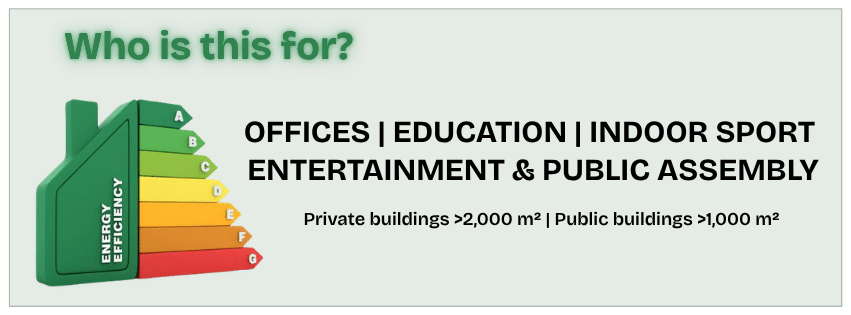
The regulations apply to specified buildings in four occupancy classes:
A1 — Entertainment & Public Assembly
Buildings where people gather for entertainment, eating, drinking, recreation and public assembly.
A2 — Theatrical & Indoor Sport
Buildings used for theatrical, cinematic or indoor sporting activities.
A3 — Places of Instruction
Schools, colleges, universities and other educational facilities.
G1 — Offices
Large multi-storey or stand-alone office buildings, banks and consulting rooms.
The applicable minimum net floor areas are:
- Public buildings: over 1,000 m²
- Private buildings: over 2,000 m²
The building must also generally have been in operation for two years or longer and must not have undergone a major renovation within the applicable period before assessment.
Mixed-use buildings can be more nuanced, depending on occupancy classification, separation of uses and the applicable assessment criteria. If you’re unsure whether your building qualifies, talk to us before making assumptions.
What is an Energy Performance Certificate?
An Energy Performance Certificate indicates how much energy a building uses to operate and provides an A–G energy performance rating, with A representing very high energy efficiency and G representing low energy efficiency.
The rating is based on measured energy consumption and is assessed against the applicable South African standards.
An EPC is valid for five years once issued.
Elevation manages the process
Getting an EPC isn’t simply about obtaining a certificate.
The process starts with accurate information about the building, its assets and its energy consumption.
Elevation REH Africa assists with:
- Site assessments
- Building asset registers
- Energy and load-profile data collection
- Compiling the information required for assessment
- Managing the EPC process with an appropriately accredited professional
- Certification and SANEDI registration
Our role is to make the process more straightforward for building owners and facilities managers — while ensuring the information required for certification is properly gathered and prepared.
From building data to energy performance
An EPC gives you more than a letter on a wall.
It gives you a measurable picture of how your building is performing.
That creates a useful starting point for identifying opportunities to improve energy efficiency, operational performance and long-term energy resilience.
And once you understand the building, you can make better decisions about what it needs next.
What happens if your building isn’t compliant?
The EPC compliance deadline passed on 7 December 2025. Failure to comply with the mandatory display requirements constitutes an offence under the applicable regulations, with SANEDI currently citing penalties of up to R5 million and/or five years’ imprisonment.
If you’re unsure whether your building requires an EPC — or where you stand in the process — don’t guess. Get clarity.
Is your building EPC-ready?
If you own or manage a qualifying commercial, educational, sporting or public assembly building, Elevation REH Africa can help you understand your requirements and manage the EPC process.
Let’s assess your building.