

19 Aug Beyond the Ice Pack: Why Real-Time Cold Chain Monitoring Matters for Diagnostic Laboratories
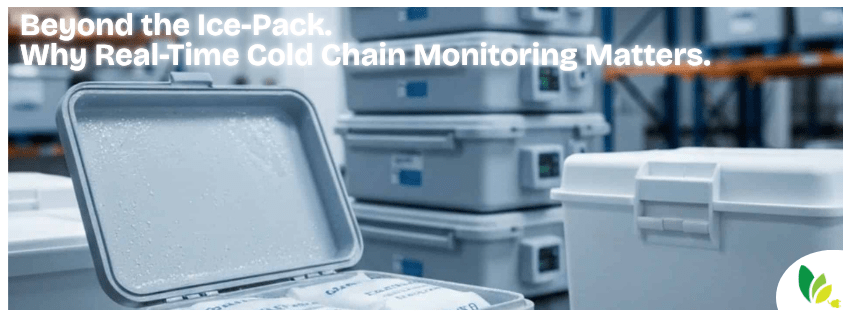
For diagnostic laboratories, an intact ice pack can tell you that a shipment arrived with its cooling mechanism apparently intact.
It cannot tell you everything that happened along the route.
Temperature-sensitive specimens may encounter fluctuations during collection, storage, loading, transport, delays and delivery. By the time a shipment reaches the laboratory, a conventional data logger may reveal that a temperature excursion occurred — but the opportunity to intervene has already passed.
This is where real-time cold chain monitoring can change the equation.
For core laboratory testing, where chemistry, haematology and immunology workflows depend on the appropriate handling of specimens, continuous visibility can provide laboratories with something a traditional end-of-route download cannot: the opportunity to know what is happening while it is happening, and act accordingly.
Not Every Diagnostic Sample Requires Cold Chain
Modern diagnostic testing is becoming increasingly diverse.
Some diagnostic kits and testing methodologies are designed to be stable across broader temperature ranges, reducing or eliminating the need for conventional cold-chain management. That means cold-chain monitoring should not be viewed as a requirement for every patient sample or every diagnostic workflow.
The issue is more specific.
Where a specimen does require controlled temperature conditions, maintaining those conditions throughout its journey remains an important part of specimen integrity and laboratory quality.
The World Health Organization notes that samples need to be transported under the temperature conditions appropriate to their preservation and that laboratories should monitor transportation conditions. (WHO Extranet)
For laboratories processing high volumes of specimens, particularly across distributed collection and referral networks, that distinction matters.
The objective isn’t to monitor everything simply because technology allows it.
It is to provide visibility where temperature control matters.
The Core Laboratory Challenge
Core laboratory services — including clinical chemistry, haematology and immunology — process large volumes of diagnostic specimens and support clinical decisions across healthcare networks.
For some of these specimens, temperature is an important part of maintaining the required conditions between collection and analysis.
Traditionally, laboratories may use temperature data loggers for applicable cold-chain samples. These devices can provide a record of conditions during transport, which can then be downloaded and reviewed once the shipment arrives.
That creates an important historical record.
But it can also create a significant operational gap.
If the data shows that a sample experienced a temperature excursion, the laboratory is potentially discovering the problem after the journey is over.
At that point, there may be little that can be done to recover the shipment.
The sample may need to be rejected, discarded or tested with an appropriate cautionary qualification, depending on the circumstances and laboratory protocols.
And the referring healthcare professional may need to be informed.
The problem has become a downstream quality issue.
From Recording What Happened to Knowing What Is Happening
This is the fundamental difference between conventional data logging and real-time temperature monitoring.
A traditional logger can answer:
“What happened to this shipment?”
Real-time monitoring can answer:
“What is happening to this shipment right now?”
That distinction has practical implications.
With continuous monitoring, temperature data can be transmitted while a specimen is in transit. If conditions move outside the defined acceptable range, an alert can provide an opportunity for intervention.
The response might involve investigating a delayed vehicle, checking refrigeration, contacting the logistics provider or taking another appropriate corrective action before the shipment reaches its destination.
Instead of discovering the excursion at the laboratory receiving desk, the relevant people can potentially know about it while there is still time to respond.
That changes cold-chain management from a predominantly reactive process into a proactive one.
Visibility Across the Diagnostic Logistics Chain
Temperature is only one part of understanding what happens to a shipment.
A modern IoT-enabled cold chain monitoring system can combine temperature information with other data points, including location and route visibility.
For diagnostic laboratories, this can create a much clearer picture of the journey from collection point to testing facility.
Real-time monitoring can provide:
- Continuous temperature monitoring for applicable specimens
- GPS location visibility during transit
- Real-time excursion alerts when conditions move outside defined parameters
- Digital records of transportation conditions
- Historical data to support investigation and quality management
- Greater visibility across distributed diagnostic logistics networks
The result is not simply more data.
It is actionable data.
Reducing Avoidable Sample Rejection
A compromised specimen creates consequences beyond the sample itself.
There may be additional collection requirements, courier costs, delays in diagnosis, inconvenience for patients and additional workload for laboratory teams.
Where a specimen is temperature-sensitive, preventing or identifying a problem earlier may therefore have operational value far beyond the monitoring device itself.
Real-time visibility does not guarantee that every temperature excursion can be prevented.
It does, however, provide the information required to identify potential problems earlier and support an appropriate response.
That is an important distinction.
The goal isn’t to promise that technology eliminates every rejected sample.
The goal is to give laboratory and logistics teams the visibility they need to make better decisions.
Turning Cold Chain Data into Diagnostic Intelligence
The next evolution of cold-chain management isn’t simply putting a logger inside a box.
It is connecting the physical movement of specimens with digital intelligence.
For laboratories, that means being able to understand where a shipment is, what environmental conditions it has experienced and whether an intervention may be required — without waiting until the shipment reaches the laboratory.
For healthcare organisations operating across complex logistics networks, this kind of visibility can support better quality management, operational efficiency, compliance and accountability.
It can also create a valuable historical dataset.
Repeated temperature excursions may reveal recurring problems in particular routes, vehicles, collection points, handover processes or logistics practices.
The data therefore becomes more than a record of individual shipments.
It becomes a tool for improving the system itself.
Elevation REH Africa: Bringing Real-Time Visibility to the Cold Chain
Through its partnership with Figorr, Elevation REH Africa brings real-time cold-chain visibility to applicable blood and specimen transportation across South Africa.
The solution provides continuous monitoring of environmental conditions, GPS-based route visibility and alerts when predefined conditions are exceeded.
For diagnostic laboratories and healthcare logistics providers, this means moving beyond the question of whether a shipment eventually arrived within acceptable conditions.
It creates the opportunity to ask a more useful question:
What is happening to our specimens while they are still in transit?
Because when sample integrity matters, an intact ice pack is useful.
Knowing what happened between collection and the laboratory is better.
And knowing while it is happening is better still.
Elevation REH Africa and Figorr.
Real-time cold chain monitoring for pathology and diagnostics.
Continuous visibility. Instant alerts. Audit-ready records.
Elevation REH Africa brings intelligent healthcare infrastructure and renewable energy solutions together to help organisations across Africa operate with greater resilience, visibility and confidence.
No Comments